Elena Rivautella, painter and photographer. First came a scream.
Then a song.
Elena Rivautella began to paint after surviving the 2004 tsunami, without ever having held a brush before. Art became her therapy. Then came photography: plants, flowers and bodies that turn into visions.
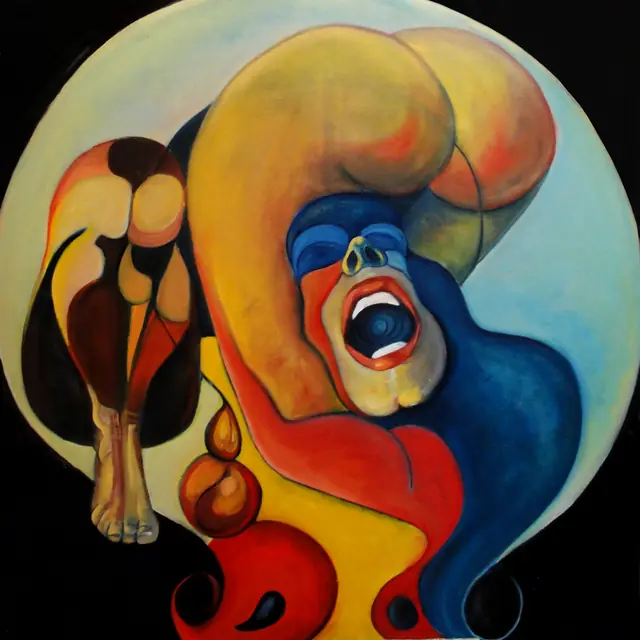
The Wave
Elena was in Thailand when the tsunami swept across the coasts of South-East Asia, and she survived. Back in Italy, she felt an urgent need to say something that could not be said out loud. She had never painted before. She picked up the brushes and began.
Painting became her way of working through what had happened: a therapy that spared her from going into analysis and helped her find her centre again. Three paintings, The Wave, Occhi and Poseidone, carry those days within them.
“Art was my therapy. It helped me find my centre again.”
Elena RivautellaShamanic period
These are the paintings made right after her return from Thailand, by someone who had never painted until then. Elena calls them her “shamanic” period: powerful, screaming works in full colours and sharp outlines, crowded with bodies, wide-open mouths, sea creatures and unsettling figures.
A vortex returns in almost all of them. The forms never stand still: they coil into spirals, turn inside a circle, get sucked towards the centre as if by a whirlpool. It is the movement of the wave, which drags and churns everything, bodies, animals and faces, until there is no longer an up or a down.
But every vortex also has a still centre. For Elena, painting was the way to reach it: the fixed point inside the whirl, from which to start again. There is no learned technique here, only a need, and the brush goes where the voice cannot.
21 works · sizes in centimetres, width × height
Middle period
Over the years the mark breaks free. The figures do not disappear but grow lighter, and colour starts to move on its own: drips, splashes, fields laid down with broad gestures. It is the passage from scream to song, played out in two shapes, the square and the rectangle.
The square
Elena's favourite format for canvas: 100 × 100 cm, a space with no privileged top or bottom.The square is the shape of sacred geometry, which Elena loves: a perfect perimeter in which every direction weighs the same. Figures still live inside this space, an underwater Harlequin or a gynaecologist who loved horses, but more and more often colour takes over. In Giungla, Robot or Notre Dame de Paris black, yellow and blue drip and intertwine until they become landscape.
The long formats
Paper, cardboard, canvas and large wooden panels almost two metres tall.Alongside the squares, the rectangular formats. Here bodies stretch and grow thin: figures drawn in line over veiled grounds, seeming to emerge from the material or dissolve into it. Lui, Donna toro and La mela di Platone, on 84 × 187 cm panels, stand upright like life-size presences; Narciso, Crisalide and Balena danzante stretch out horizontally. Mixed media prepares what is to come: colour that flows.
Liquid period
For Elena, the liquid period was a challenge. Liquid colours cannot be governed: you throw them onto the paper and then follow them, intervening in their flow. It takes a great deal of trust, above all in the gesture, because the result can never be fully foreseen.
Working this way put her face to face with herself. The need for control was a part of her that had to be seen and worked through, and each sheet became a way of observing her own personality and its many facets. From the stains come flowers, wings, fish, spirits and landscapes: visions nobody had planned, carrying the emotion of the moment the colour fell.
26 works
Alcohol inks
The first liquid works: alcohol inks spread with an air compressor, which blows the colour and makes it open out on the paper.Indian inks, Ecoline, watercolours and spray paint
Then liquid colours of every kind, thrown, poured and sprayed.Faces
A new experiment. Elena cut a passe-partout in the shape of a face, a human profile, and laid it over small abstract paintings made with Indian ink and Ecoline. The face is the rational form; behind it, the free colour of the unconscious.
By turning the passe-partout, each painting can become eight different paintings: the same ground, seen through another window, gives back a new face every time. It is the idea the curator Francesca Canfora captured when presenting these works at Through the Black Mirror (Base, Milan): it is the mirrors of the unconscious that transpose rational forms and figures, and the surreal emerges guided by instinct.
Photography
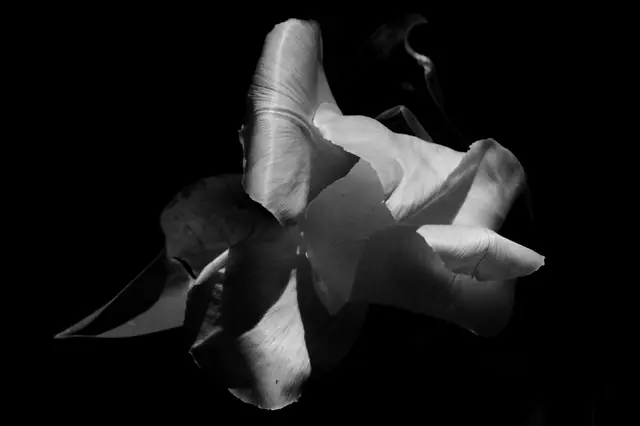
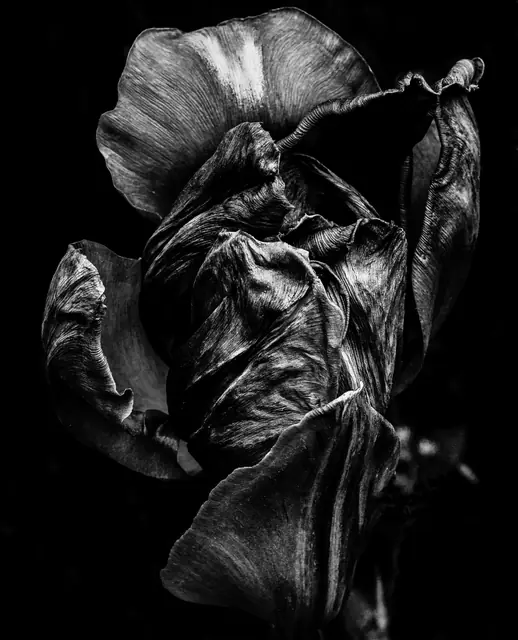
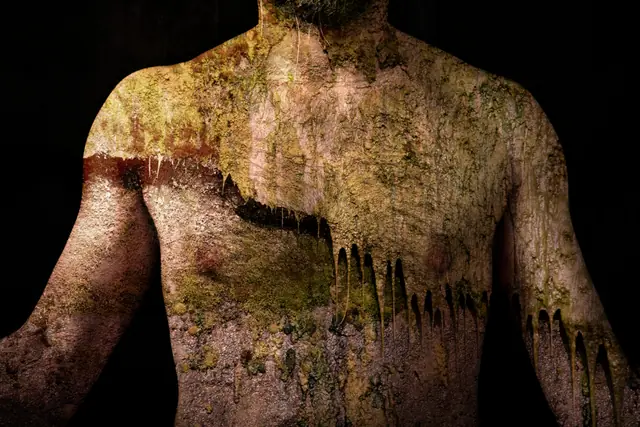
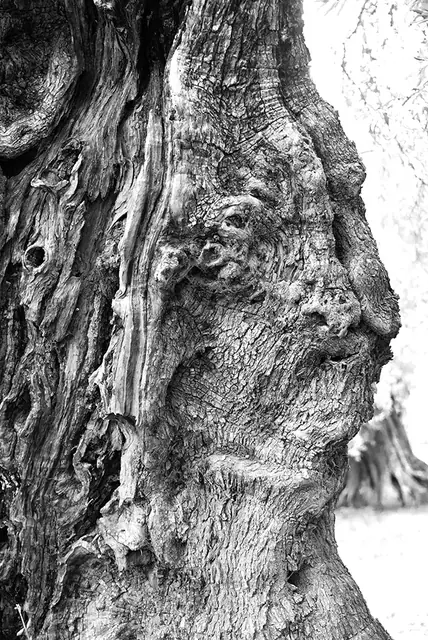
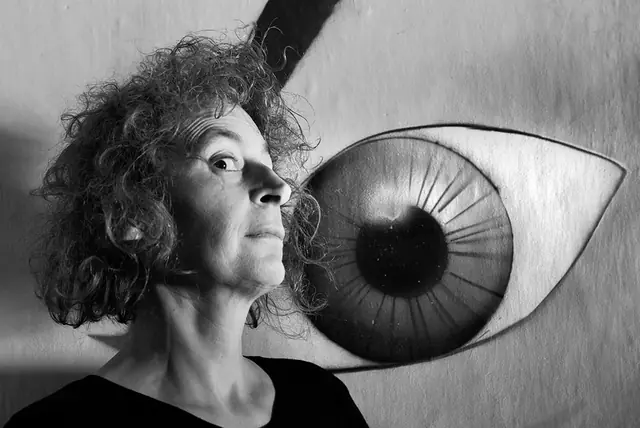
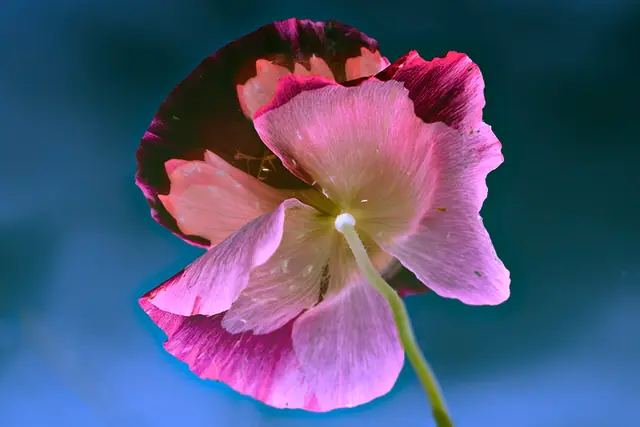
In photography Elena takes the same adventurous approach as in painting. She loves to portray her unsettling visions through physical bodies: plants, flowers and human bodies. Here too, the forms allude and never declare.
Seven series, from the thousand-year-old olive trees of Sardinia to the flowers of her own garden, up to her first portfolio, Casa folle casa. Choose a series to open it.
All photographs are limited editions, signed and numbered prints. Information on request →
Books
Alongside painting, writing: the account of what happened, and a dreamlike journey between photography and words.

L'onda che mi ha salvata
“The wave that saved me” · A memoir of survival · The tsunami of 26 December 2004
A first-person account of surviving the tsunami, and of how that wave opened the way to a new life and to painting. On the cover, the painting The Wave.
Buy on Amazon
Vuoto fitto
“Dense Void”: a dreamlike book, 20 × 30 cm, in which the photographs become the inhabitants of an imaginary archipelago, accompanied page after page by a story.
Ask for informationI want to tell you a story. A story about a mysterious place at the far end of the “Dense Void”: the archipelago that isn't there. I got there by chance, on my last journey aboard a supersonic spaceship piloted by the man of stone.
In the sea around the archipelago lives the sunflower whale, the gentlest of animals, which feeds only on stink bugs and hornets, and the flying fish, which fears nothing and dares the highest heights. In the wood lives the redred wolf, undisputed master of nights lit by animated moons, the plastic, talking ones. From moonrise to moonset they whisper: “I see you”, “I am the moon of the 19th of April”, even when it is February.
They say that on these nights the women gather under the witch trees, strange and sinful trees, and that, after tracing the secret scribble on the ground…
The rest is in the book · ask for informationAbout


Elena Rivautella had never held a paintbrush when, on 26 December 2004, the tsunami swept across the coasts of South-East Asia. She was in Thailand, and she survived. Back in Italy, she felt the need to say what could not be said out loud, and she began to paint. Art became her therapy: it helped her work through what had happened and find her centre again.
Her first paintings are powerful and screaming, crowded with unsettling figures and crossed by a vortex that returns in almost every canvas. Elena calls this her “shamanic” period. Over the years the scream turned into a song. Her mark broke free within her favourite shape, the square of sacred geometry, and then her painting became abstract. From oil she moved to liquid colours, which refuse to be controlled: a challenge that led her to look closely at her own need for control and at the many facets of her personality.
With the same adventurous spirit she turned to photography. She portrays her visions through physical bodies: plants, flowers and human bodies, from the thousand-year-old olive trees of Sardinia to the flowers of her garden. Alongside the images, two books were born: L'onda che mi ha salvata, the account of her survival, and Vuoto fitto, a dreamlike journey between photography and words.
In painting as in photography, her forms allude and never declare, leaving viewers free to find their own place within the work. Elena loves to explore madness and pours it, with irony, into everything she does.
She has exhibited in Italy and abroad, from Turin to Milan and Rome, from London to Hong Kong and Switzerland. She lives and works in the Langhe, in Piedmont.
Exhibitions
From Turin to London and Hong Kong, from Milan and Rome to Switzerland: 31 exhibitions in twenty years.
- YouniqueLugano · Villa Ciani
- Younique Fine Art districtLugano · Villa Ciani
- WOP ARTLugano · Centro Esposizioni
- Luce soffusaCaslano · Museo Sergio Maina
- Donna FotografaTurin · CRDC
- The Honesty of the BodyTurin · Galleria Marvin
- NeedsBologna · Magazzini Romagnoli
- Night BloomsTurin · Ph.ocus · Ex accademia artiglieria
- Due donne, i loro gestiTurin · Paratissima · Ex accademia artiglieria
- Women art BraBra · Movicentro
- Zitto e UrlaTurin · Galleria Ossimoro art
- Through the black mirrorMilan · Base
- Digital art factoryRome · Palazzo Velli
- Feeling differentTurin · Paratissima 14 · Caserma La Marmora
- Lucenti TenebreTurin · Galleria Ossimoro Art
- To the starsTurin · Paratissima 12 · Torino Esposizioni
- Sicurezza e Individui su telaTurin · Unimanagement
- HereTurin · Cavallerizza Reale
- OpereAlba · Showroom Marcarino
- Women art BraBra · Movicentro
- SuperstitionTurin · Paratissima 13 · Caserma La Marmora
- Madre ItalyLondon · Art Gallery The Tabernacle
- Asia Contemporary Art showHong Kong
- Notti di lunaMoncucco Torinese · Castello di Moncucco Torinese
- Ordine o caos?Turin · Paratissima 11 · Torino Esposizioni
- Percorsi di estetica contemporaneaTurin · Galleria 20
- Not wrong but creativeTurin · Paratissima 10 · Torino Esposizioni
- Saturarte associazione saturaGenoa
- Pix Paratissima PowerTurin · ex Moi
- Arte e Luce della RagioneTurin · Villa Gualino, RGCastle
- Osare significa creareTurin · Spazio Via Oropa 28